 November 11, 2026
Website Development for Manufacturers: What B2B Buyers Check
A lot of factory websites read like a brochure: a photo of the building, a welcome note from the director, a vision and mission, then a phone number. The trouble is that people rarely visit a factory website to be impressed. They are procurement staff building a vendor shortlist, project buyers who need parts made to spec, distributors looking for a new supplier, or importers who have never set foot in Indonesia. They open your website to rule vendors out, not to fall in love. If it does not answer their questions, you get crossed off first, even when your plant could easily do the job.
Our general approach is on the Bienara website development page. This article is written for owners and directors of factories, garment makers, and B2B manufacturers, whether you make food, plastics, packaging, apparel, or metal products. It covers what buyers check before requesting a quote, which pages you need, what a useful RFQ form looks like, and what moves the cost of building one.
Who actually opens your factory website
B2B purchases are rarely a one-person decision, and each person in the chain is looking for something different.
- Procurement and purchasing. They have to justify the vendor choice to a manager or an auditor. They look for legal standing, capacity, proof you have supplied similar companies, and whether you are listed on the procurement catalogues they use.
- Project buyers and technical teams. They arrive with drawings or a spec sheet. They look for materials, tolerances or dimensions, product certifications, and whether you can build to their spec rather than only from your standard catalogue.
- Distributors and resellers. They are working out margin and supply reliability. They look for MOQ, packaging, consistent stock, and which territories are already taken.
- Importers and overseas buyers. They cannot drop by. They look for proof the factory is real, export readiness, the documents you can prepare, and a language they can read.
A single "About Us" page cannot answer all four. That is why a useful manufacturing website is built from buyer questions, not from a company profile PDF pasted onto the web.
What B2B buyers check before asking for a quote
Looking at how procurement teams and project buyers screen suppliers, the list usually comes down to this:
- Production capacity. A monthly or per-batch figure, stated plainly. Buyers trust a realistic number more than "large capacity" with no unit attached.
- MOQ. Minimum order per model, colour, or size. If the MOQ can flex for a trial order, say on what terms.
- Specifications and materials. Material type, thickness, grade, standard sizes, finishing options. For technical products, offer a downloadable spec sheet.
- Certifications you actually hold. Quality management, national standards, halal, food registration, or local content (TKDN) certificates if you sell into Indonesian government and state-owned enterprise tenders. Name the certificate and its scope. Do not display logos for certificates still in progress, or ones that belong to your raw material supplier.
- Real photos of your production lines. Machines, the shop floor, the warehouse, QC, and people at work. Stock photos of an overseas plant make buyers suspicious.
- How an order runs. From sample request and sample approval to PO, production, QC, shipping, and invoicing. Include lead times per stage if you can genuinely hold to them.
- Legal standing. The registered company name that will appear on the invoice, the factory address, and a note that company documents are available on request. The full documents do not need to be public.
- Procurement catalogues. If you are listed on Indonesia's LKPP e-Catalogue, PaDi UMKM, or a specific company's vendor portal, say so. For institutional buyers, this is often a precondition for ordering at all.
If any one of these takes more than a few clicks to find, buyers usually do not ask. They move on to the next vendor on the list.
Pages a manufacturing website needs
Treat the structure below as a starting point. The number of pages depends on how many product lines and buyer types you serve.
One page per product line
Give every line that people search for by a different name its own page. A plastics plant might separate bottles, jerry cans, and caps. A packaging maker might separate corrugated boxes, standing pouches, and labels. Each page carries specs, MOQ, custom options, real product photos, and a quote button for that line. Separate pages are easier to read and easier to find on Google, because buyers search for the product, not your company name.
One page per buyer industry
If your products serve several industries with different needs, write a page for each. Packaging for food, cosmetics, and pharmaceuticals raises different questions about safe materials and supporting documents. Uniforms for factories, hospitals, and security firms differ too. Buyers get comfortable faster when they see a page that names their own industry.
Production and quality control
Walk through your production flow with photos of each stage, your main machinery, and how QC is done. This page answers the questions that usually only come up during a factory visit, so buyers can start trusting you before they travel.
Order flow and samples
Describe the sample, PO, production, and shipping sequence as it really runs, including who pays for samples and how revisions are handled. First-time buyers then know exactly what happens after they get in touch.
The RFQ (request for quotation) form
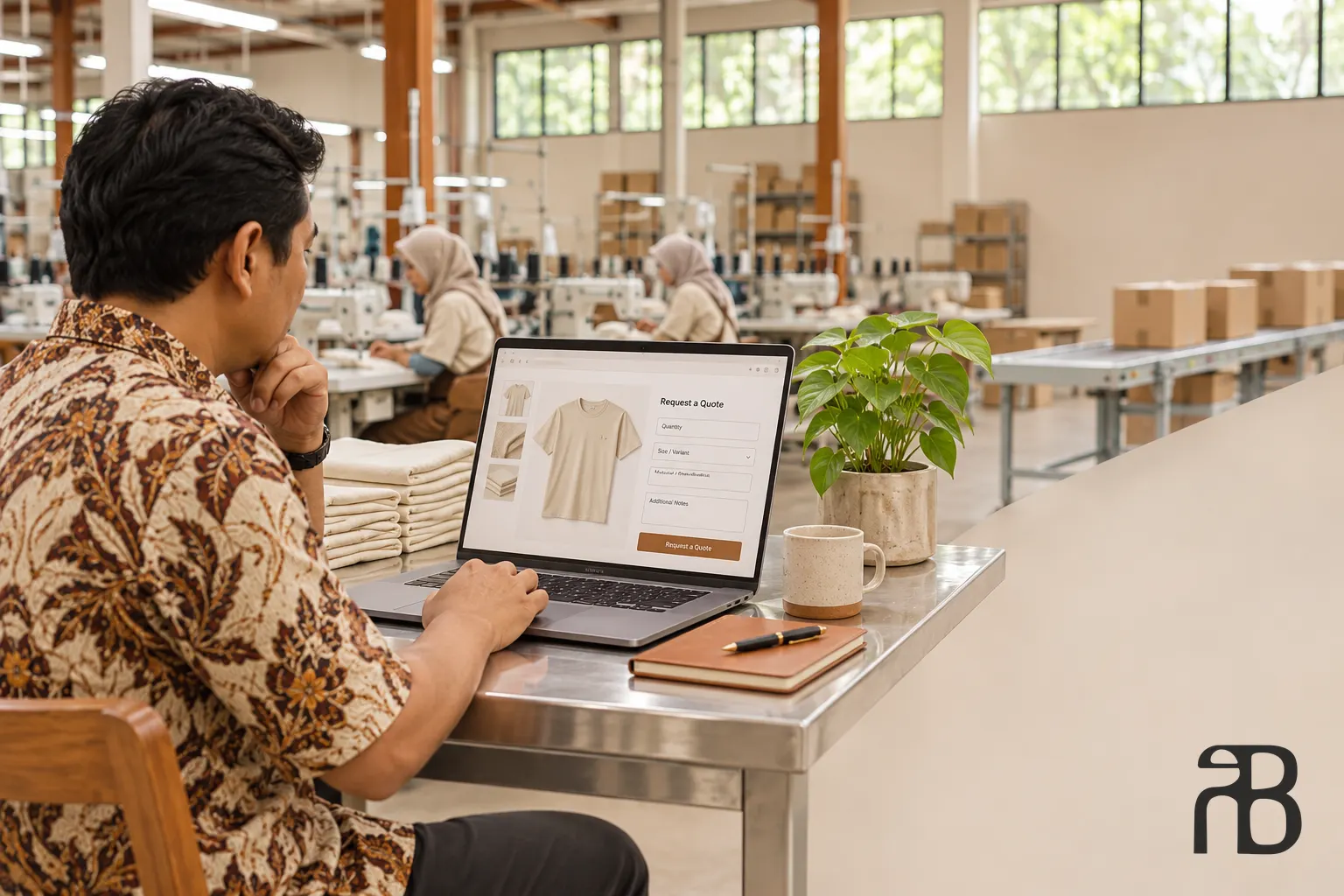
A generic "Contact Us" form with name, email, and message almost always leads to rounds of back-and-forth just to get the basics. A good RFQ form asks for what your sales team needs to price the job:
- Company name, sender's name and role, work email, WhatsApp number
- The product or line requested, with a field to upload drawings or references
- Estimated quantity per order, and whether it is a one-off or recurring
- Key specs: material, size, colour, packaging, or printing and embroidery for apparel
- Target delivery date and destination city or port
- Whether a sample is needed first, and which documents procurement will require
Do not make every field mandatory. Require only what actually determines the price and leave the rest optional. Submissions should land in the sales inbox and be logged in one place, so no request gets buried.
An English version, if you have overseas buyers
If you already sell to importers, or want to, write an English version for them rather than running the Indonesian site through a translator. Importers ask things local buyers do not: the incoterms you usually work with, your port of loading, capacity per container, and the export documents you can prepare. If you have not exported before, do not write as if you have. Describe your readiness honestly.
Example: a B2B uniform manufacturer
One example from our work is Pramika Uniform, a B2B uniform manufacturer in Jakarta. Its buyers sit in HR, GA, and procurement, so the website was built around them. The menu follows the product types people search for: PDH shirts, PDL field shirts, wearpacks, security uniforms, and medical uniforms. Operational proof is shown up front: workshop photos, a capacity of 10,000 pieces per month, and its listings on the LKPP e-Catalogue and PaDi UMKM.
On the technical side, the old site was migrated from WordPress to Next.js without losing any URLs Google had already indexed, and WhatsApp clicks are tracked per channel so it is clear where enquiries come from. You can see it in the Bienara portfolio. For a few more examples and how their pages are structured, see our company profile website examples.
How we build it
We start by talking to whoever fields buyer questions most, usually sales or admin. From there we collect the questions that come up most often before a quote goes out and turn them into a page map. All of this can run over video calls and WhatsApp.
We sort out the copy first, then shape the design around it. For photos, we ask for production lines to be shot while the factory is running, not with the machines off and the floor empty, because that is what convinces buyers. If you already have a site indexed on Google, we map the old URLs first so pages that already bring visitors are not lost.
Before launch, we test every RFQ form and WhatsApp button until the message actually reaches the right person. After launch, we set up measurement per product page, so you can see which lines generate the most quote requests.
What moves the cost of a factory website
We do not list prices here because the range is wide. For manufacturers, the biggest differences usually come from these:
- Number of product lines and items. Five lines with short specs is far lighter than hundreds of SKUs that each need a spec table.
- Materials. Ready production photos and spec data save time. A photo shoot at the plant and writing spec sheets are separate jobs.
- Language. An English version written for importers adds writing work, not just translation.
- RFQ flow. A form that only sends an email is lighter than one that logs automatically into a spreadsheet or sales system.
- Migration. Moving an older site with many indexed pages needs careful URL mapping.
Ask for recurring costs such as domain, hosting, and maintenance to be listed separately from the build. We break those components down in our article on website development costs.
When a factory website does not need an overhaul yet
If almost all your orders come from long-standing customers on annual contracts and you are not looking for new buyers, a simple site that is tidy and accurate is enough. The same goes when your capacity is fully booked: a site that pulls in quote requests you cannot fulfil damages your name with buyers. And if nobody can reply to an RFQ within one or two working days, fix that before adding pages.
Frequently asked questions
Should a factory website show prices?
Not necessarily, and for custom products it usually cannot. It is more useful to explain what drives the price, such as material, order quantity, and finishing, so buyers know what to send to get an accurate quote.
How is this different from a regular company profile website?
A general company profile site introduces the business. A factory website has to go further: specs, capacity, MOQ, order flow, and an RFQ form.
Can a factory website rank on Google for product names?
It can be worked toward, but it takes time and is a separate piece of work. Product-line and industry pages set up from the start make it easier. If winning buyers from search is the main goal, see Bienara's SEO service.
Can I use photos from my machine supplier, or stock photos?
Best not to for production photos. B2B buyers, importers especially, often compare website photos with what they see on a visit or video call. Simple but genuine photos are safer than polished ones that are not yours.
If you are weighing up website development for your factory or garment business, prepare three things before we talk: who your main buyers are, the five questions they ask most before requesting a quote, and the product line you most want to push. Send us a WhatsApp and we will reply within 1-2 working days with a proposed page structure and timeline. No hard sell.
All posts