 November 19, 2026
Hotel, Guest House, and Homestay Website Development
Bienara builds websites for small and mid-sized hotels, guest houses, and homestays in Indonesian cities that want more guests to book direct instead of only through OTA apps. What we build: one page per room type with real photos, a WhatsApp button that carries the room type and dates into the chat, a location page that answers "close to what?", a site that matches your Google Maps profile, and tracking so you can see which bookings came from the website.
This page is about city hotels and guest houses, the kind whose guests come for work, family matters, or a stopover. If you run a holiday villa that fills up with weekend groups, the pattern is different, and we covered it in our article on villa and guesthouse websites in Malang-Batu.
City hotel guests are not holiday guests
A 20-room hotel near a train station, a guest house near a campus, or a homestay next to a hospital serves people with a clear reason to be there and little time to decide. Their questions differ from a villa guest's. Before booking, they usually want to know:
- Business and company guests. They need a receipt or invoice in the company's name, sometimes with a tax ID. They ask about Wi-Fi, a desk, breakfast hours, and late check-in.
- Families with something to attend. A graduation, a relative's wedding, or a family member in hospital. They look for distance to the venue or hospital, rooms for three or four, extra beds, and parking.
- Stopover and same-night guests. Already in town, opening Google Maps on their phone, and wanting a confirmed room within minutes.
- Long-stay guests. Project workers, training participants, or new students staying for weeks or months. They need a special rate and clear house rules, and OTA listings rarely have room for that.
Long-stay guests and company bookings are the easiest to move to direct booking. They need a conversation, not just a pay button, and they are often worth more than a single night.
The typical problem: OTAs own your hotel's own name
Search your hotel's name plus your city. For many small hotels, the top results are booking apps and price comparison sites, while the official website is missing or buried. So a guest who already knows you, say through a colleague's recommendation, still gets routed through a middleman.
The first job of a hotel website is to win searches for its own name. That is far more realistic than chasing "hotels in [city]" right away. It takes a site whose name, address, and phone number exactly match your Google Maps profile, hotel structured data in the page code, and a link to the site from your Google profile, Instagram, and booking confirmations.
Pages a hotel website needs
You do not need many pages. The rule is simple: every question your front desk answers in chat every day deserves a written answer on the site.
- One page per room type. Size, bed type, capacity, whether there is a window, bathroom, hot water, whether breakfast is included, and extra bed rules. If a room has no window, say so, rather than let guests find out at check-in.
- Location and distances. Distance and travel time to the places your guests care about: station, airport, bus terminal, campus, hospital, industrial estate, event venue. This is also what makes you relevant for "hotel near ..." searches.
- House policies. Check-in and check-out times, early check-in, deposit, ID requirements, cancellation, smoking, pets, parking.
- Company and group bookings. A separate form or WhatsApp button for corporate rate requests, invoices, and multi-room bookings.
- Meeting or event space, if you have it: capacity, seating layouts, and available packages.
- Weekly or monthly stays, if you offer them: what is included (electricity, room cleaning, laundry) and how to ask for a rate.
If some of your guests are foreigners, for example near an airport or in a city tourist area, plan the English version from day one. Write it around their questions instead of translating word for word.
WhatsApp or a booking engine?
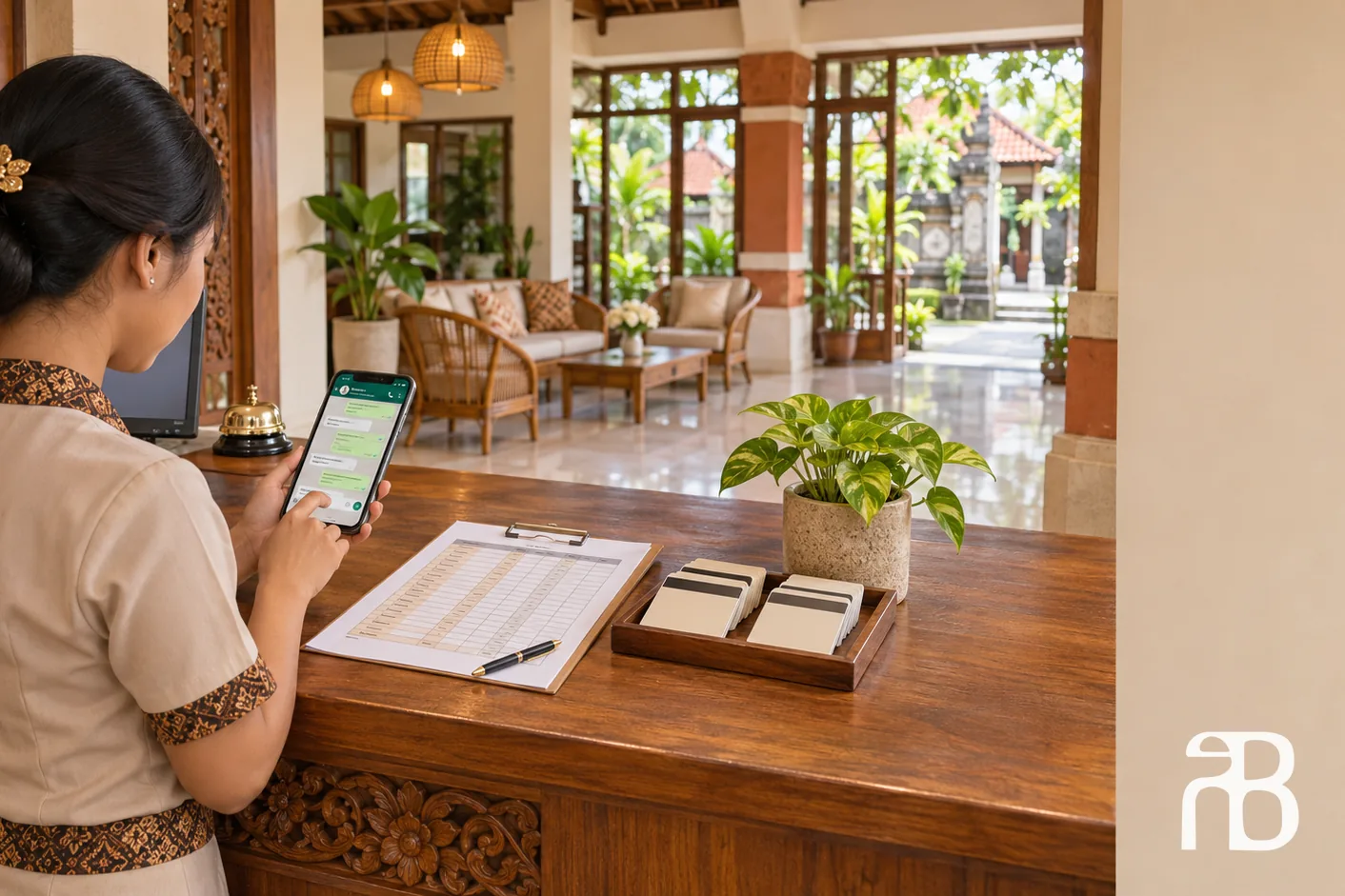
For guest houses and small hotels that still track reservations by hand, WhatsApp is the flow that usually works. A guest opens a room page, taps the button, and the message already contains the room type, check-in and check-out dates, and number of guests. The front desk checks availability and sends payment instructions.
Two things often get missed. First, the WhatsApp button should go to a number the front desk holds, not the owner's personal phone that goes quiet at 10 pm. Second, separate individual guests from company requests, so invoice or group enquiries do not get lost among one-night price questions.
A booking engine with online payment makes sense once you already use a channel manager or reservation system that keeps room inventory in sync across channels. Without that, a website calendar that is not connected can sell a room already taken on an OTA. We usually suggest starting with WhatsApp, then connecting a booking engine from the provider you use once operations are ready. One more note: before offering a special direct-booking rate, check the pricing terms in your OTA contracts.
Local SEO for hotels: start realistic
Page one for "hotels in [city]" is almost always booking apps, comparison sites, and Google's hotel map box. A single small hotel's website rarely wins there, and we will not promise it. What you can realistically go after:
- A complete, accurate Google Business Profile. The right category, recent room photos, check-in hours, a working number, and a link to the website. The steps are in our Google Business Profile guide, and if you would rather have it done for you, see Google Maps optimisation.
- Place-based searches. "Hotel near ... station", "guest house near ... campus", "lodging near ... hospital". Volumes are small, but the people typing them know exactly what they need.
- Genuine reviews. Ask happy guests to leave a Google review and link to it. Do not write testimonials yourself.
For guest houses and homestays, the prices and open dates shown in Google's hotel box usually come from OTAs or from a booking engine provider connected to Google. If you want your official site to appear there, ask your reservation system provider whether they support it. Longer-term SEO work runs through Bienara's SEO service.
How we work
We start by asking for the questions your front desk or WhatsApp admin gets most, plus who your main guests are. From there we map the pages: which room types need their own page, which landmarks to mention, and which booking paths to separate. Copy comes first, then the design follows it.
Before launch, we test every WhatsApp button and form until the message reaches the right number with the right content. The name, address, and phone number on the site are matched to your Google profile. After launch, WhatsApp clicks are recorded per room type and per page, the same way we describe in our article on tracking WhatsApp clicks. You just log the source of each reservation in your guest book or system: OTA, WhatsApp from the website, or returning guest.
If the real problem turns out to be how reservations are recorded, for example room availability kept in three different places, that is an internal system job rather than a website job. How we build websites in general is on our website development service page.
What drives the cost
We do not publish prices, because the difference comes from these factors far more than from the number of pages:
- Number of room types. Three room types are much lighter than twelve, each with its own photos and details.
- Photos. Usable room photos save time. A new photo shoot is separate work.
- Booking path. A WhatsApp button and corporate form are lighter than connecting a third-party booking engine.
- Languages. An English version means writing for a different reader, not pasting a translation.
- Extra pages. Meeting rooms, long-stay packages, or location pages for each destination.
Ask for recurring costs (domain, hosting, maintenance) to be listed separately from the build. We break down the components in our article on website development costs.
When you do not need a website yet
If you only have a few rooms, nearly all guests come through OTAs, and nobody asks how to book direct, a well-kept Google Maps profile may be enough for now. The same goes if nobody can answer chats in the evening. A hotel website that invites questions but answers them slowly sends guests back to the app, where they can lock in a room on the spot.
Frequently asked questions
Does a hotel website need an online booking system?
Not necessarily. For small hotels and guest houses, a WhatsApp button that already carries the room type and dates is often enough, as long as replies are quick. A booking engine is worth adding once room inventory runs through a channel manager.
Does having a website mean leaving OTAs?
No. OTAs still bring guests who have never heard of you. The website is the direct route for guests who already know your name, returning guests, and company bookings.
Can we rank for "hotels in [city]" right away?
Do not count on it any time soon. That page belongs to OTAs and comparison sites. Better early targets are searches for your hotel's name, "near ..." searches, and your Google Maps profile.
Does a two or three-room homestay need a website?
Often not yet. Start with a Google Maps profile and a WhatsApp catalogue, then add one simple page once guests keep asking the same detailed questions.
If you would like a picture of what your hotel or guest house needs, send us a WhatsApp with the property name, number of room types, and where most guests come from today. You can also browse our past work first. We reply within 1-2 business days with a suggestion of which pages to build first. No hard sell.
All posts